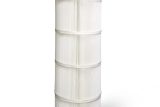
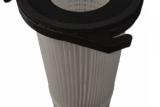
Antistatic membrane cartridge filter C2.500.8.PTF.ANT is capable of capturing smaller dust fractions than bag filters and is designed to purify air from fine dry particles that do not stick together. Filter regeneration is carried out with compressed air in automatic mode. Filters are made in Italy, comply with EU quality standards.
Material – 100% polyester with PTFE membrane, material density – 260 g/m2.
Cleaning efficiency – 100% for particles larger than 0.3 microns.
Advantages of the cartridge filter from Aton Service LLC (manufactured in Italy):
1) High cleaning efficiency;
2) Large filtering area in one filter due to corrugation of the filter material;
3) Wear resistance;
4) Long service life – 2-3 years.
5) Cartridge filters have a BIA-certificate of filter media according to USGC class (M).
6) Cartridge membrane filters have class H 13 – 0.3 microns according to EN 1822.
7) Water-repellent
Made of 100% polyester spunbond with PTFE membrane, cartridge filters will improve the level of air purification and the efficiency of equipment in production. Can be installed in minutes.
Initial efficiency

Material 100% polyester spunbond with PTFE membrane, white
Density 260 g / m2
Thickness 0.72 mm
Max. tensile strength 500 N / 5 cm
Elongation at max. strength 30%
Pressure test

Air permeability 90 l/m2 sec (200 Pa)
Max. temperature 150 ° C. Pollution ISO Fine (200 mg / m3)
Air flow 200 m3/m2 x h
Face speed 0.056 m/sec
Test area 100 cm2
BIA-test

A filter should not let anything through – this is a statement we hear very often. Many people think that a filter retains 100% of the dust. In principle, a filter is a separation device; this means that it separates the proposed material for filtration. The separated product is returned back to the production process or to residual disposal. The particles contained in the exhaust air are called residual dust. Residual dust is stated in mg / m³.
EN 1822

The standard applies to high-efficiency and very high-efficiency air filters with ultra-low penetration, used in the field of ventilation and air conditioning, as well as in technological processes such as clean room technology or the pharmaceutical industry. It establishes a procedure for determining the efficiency based on a method that counts particles using a test liquid aerosol (or, alternatively, a solid), and can classify these filters in a normalized way depending on their efficiency.





Reviews
There are no reviews yet.